
The Public Health AeroBiology Laboratory (PHAB Lab) brings together interdisciplinary research focused on understanding how airborne biological agents move through the environment and affect public health. Through laboratory studies, field investigations, and innovative measurement approaches, PHAB Lab researchers work to address emerging public health challenges and strengthen our understanding of the air we breathe.
Click a Project to Learn More

Human-to-Human Transmission Studies (aka the GotFluToo Study)
Part of the NIAID Centers of Excellence for Influenza Research and Response (CEIRR)
Sponsor: National Institute of Allergy and Infectious Diseases (NIAID)
Principal Investigator: Don Milton (UMD SPH)
Co-Investigators: Jelena Srebric (UMD ENG), Charles Ma (UMD SPH)
Objectives:
- Identify acute respiratory infection (ARISs) outbreaks and describe environmental factors that facilitate transmission; and
- Test the hypothesis that building ventilation at <5 liters per second per person is associated with high risk of ARIs like influenza and SARS-CoV-2
This research will provide evidence of the effectiveness of ventilation as a control measure for ARIs, which is especially relevant in preventing and preparing for outbreaks and pandemics since vaccines and other medical interventions take time to develop
- The target population is the UMD and surrounding community within walking distance of campus who share a bedroom but not bed with one or more roommates.
- The goal is to enroll up to 1,000 roommate pairs (2,000 participants) over the course of 4 years.
- The following items are collected from individuals:
- Online consent
- Questionnaires
- Biological specimens (nasal swabs, saliva, blood)
- Environmental data (CO2, PM2.5, air temperature, etc.)
- Exhaled breath samples
- Participants will receive compensation for their time.

Are you a study participant?
Sponsor: National Institute of Allergy and Infectious Diseases
Participating Institutions/Departments: UMD SPH, UMD Clark School of Engineering, UMD CBMG; UMSOM in Baltimore; University of Hong Kong School of Public Health; Icahn School of Medicine at Mt. Sinai; Global Health Institute at the University of Wisconsin-Madison; University of Michigan School of Public Health; Aerosol Dynamics
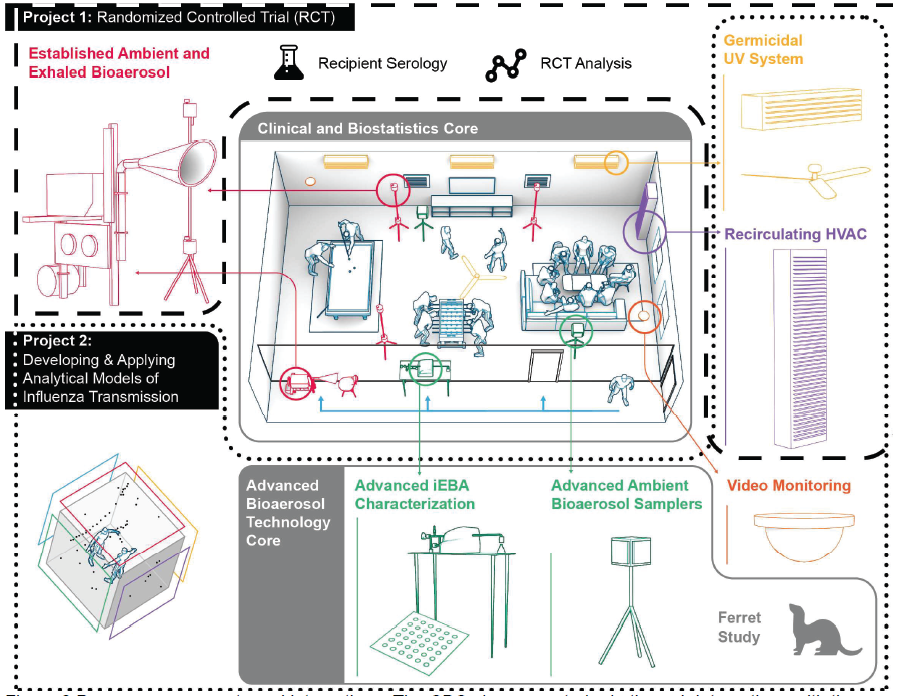
Project 1 (Evaluating Modes of Influenza Transmission using a Randomized Controlled Trial, EMIT-2-RCT)
Lead Investigator: Don Milton, UMD SPH
Co-Investigators: Ben Cowling, HKU SPH; Aubree Gordon, UMich SPH; Florian Krammer, Mt. Sinai School of Medicine
- Identify the dominant mode of transmission using naturally infected influenza donors in an RCT of air sanitation-ventilation and hand hygiene-face shield interventions.
- Determine the impact of aerosol exposure on disease severity.
- Investigate the impact of serologic and mucosal antibody levels on influenza transmission, susceptibility and immunologic response to infection.
Project 2 (Developing and Applying Analytical Models of Influenza Transmission)
Lead Investigator: Jelena Srebric, UMD ENG
Co-Investigators: Aubree Gordon, UMich SPH; Gabriele Neumann, UWis GHI
- Support the cohort study experimental setup: face shield, ventilation, UR-GUV application
- Develop two analytical models for source characterization:
- A high-fidelity model to identify variability in risk due to temporal and spatial distributions of virus concentration.
- A well-mixed model (for well-mixed conditions) using CO2 as a stand-in to assess viral aerosol exposure and dose. - Apply the analytical models to house cohort & ferret studies
Clinical and Biostatistics Core (CBC)
Lead Investigator: Kate McPhaul, UMD SPH
Co-Investigators: Wilbur Chen, Justin Ortiz, Shuo Chen, UMSOM
- Provide regulatory and safety infrastructure for a randomized controlled trial of influenza transmission.
- Screen for health adult volunteers (Recipients), willing to be exposed to community acquired influenza during the influenza season, and index cases with acute influenza infection (Donors).
- Expose un-infected eligible volunteers (Recipients) to influenza-infected index case patients (Donors).
Advanced Bioaerosol Technology Core (ABTC)
Lead Investigator: Don DeVoe, UMD ENG
Co-Investigators: Meg Scull, Gregg Duncan, UMD CMBG; Arantza Eiguren-Fernandez, Greg Lewis, Aerosol Dynamics; Yoshihiro Kawaoka, Gabriele Neumann, UWis GHI
- Develop a compact platform for ambient sampling and culture.
- Develop an instrument for efficient exhaled breath sampling.
- Develop a hydrogel collection target and an optimized cell line for enhanced infectivity analysis.
- Develop a digital culture microarray to study distribution of viable virus in aerosols.

Germicidal Ultraviolet (GUV) air disinfection is a technology that has been used for decades, and it’s safe and effective in inactivating viruses and other pathogens in the air. While ventilation and filtration are widely recommended to reduce risk of inhalation transmission, these interventions on their own cannot stop superspreading events. GUV air disinfection holds the promise of being able to stop these events, especially when layered with other preventative measures. Widespread adoption of GUV would allow us to pursue normal social and economic activities.
With the support of the Balvi Foundation, we have several projects that tackle some of the obstacles encountered for widespread adoption
Public Attitudes and Communications Research
A critical component essential to widespread GUV implementation is public understanding and acceptance of the technology. This project aims to conduct a number of focus groups with different audiences, that will then inform clearer messaging and communication strategies around the use of GUV. With this project, we’ll also develop a GUV Information Hub that will be accessible to the public.
Training and Certification of Technicians and Contractors
A major barrier of implementation is a lack of trained workforce. Funding for this program has facilitated the creation of The GUV Workforce Training Program, which entailed the design of course materials through expert consultation and training of trainers for educating and certifying professionals in the US and abroad in safe planning, design, implementation, and maintenance of GUV in public spaces. We have hosted three of the training sessions here in SPH within the last year and a half, and have also developed an apprenticeship level program that will be available to access online for free.
Optimization of Far-GUV Installation Designs
The GUV-optimization study aims to address some of the obstacles preventing its widespread use by identifying the best far-GUV installation designs. Lab experiments will aid in this process by exposing bacteriophages and influenza virus to different UV doses, and using those results to inform designs in a field trial to demonstrate real-world effectiveness of 222 nm GUV in inactivating viruses and other pathogens. This will also allow further inspection on the effect of GUV on indoor air chemistry. Furthermore, there are plans to conduct RCTs to provide evidence of its effectiveness.
StopCOVID (2020-2023)
Publications:
Lai J, Coleman KK, Tai SS, German J, Hong F, Albert B, Esparza Y, Rastogi D, Srikakulapu A, Kalliomäki P, Schanz M, Smith AA, Sierra Maldonado I, Oertel M, Fadul N, Gold TL, McPhaul K, Ma T, Cowling BJ, Milton DK. Relative efficacy of masks and respirators as source control for viral aerosol shedding from people infected with SARS-CoV-2: a controlled human exhaled breath aerosol experimental study. EBioMedicine. 2024 Jun;104:105157. https://doi.org/10.1016/j.ebiom.2024.105157
Lai J, Coleman KK, Tai SH, German J, Hong F, Albert B, Esparza Y, Srikakulapu A, Schanz M, Sierra Maldonado I, Oertel M, Fadul N, Gold TL, Weston S, McPhaul K, Frieman M, Milton DK. Exhaled Breath Aerosol Shedding by Highly Transmissible Versus Prior SARS-CoV-2 Variants. Clinical Infectious Diseases (2022), ciac846, https://doi.org/10.1093/cid/ciac846
Lai J, German J, Hong F, Tai S-H, McPhaul K, Milton DK, University of Maryland StopCOVID Research Group. Comparison of Saliva and Midturbinate Swabs for Detection of SARS-CoV-2. Microbiology Spectrum (2022), https://doi.org/10.1128/spectrum.00128-22
Adenaiye O, Lai J, Bueno de Mesquita PJ, Hong F, Youssefi S, German J, Tai S-H, Albert B, Schanz M, Weston S, Hang J, Fung C, Chung HK, Coleman KK, Sapoval N, Treangen T, Maljkovic Berry I, Mullins K, Frieman M, Ma T, Milton DK, University of Maryland StopCOVID Research Group. Infectious Severe Acute Respiratory Syndrome Coronavirus 2 (SARS-CoV-2) in Exhaled Aerosols and Efficacy of Masks During Early Mild Infection, Clinical Infectious Diseases (2021), ciab797, https://doi.org/10.1093/cid/ciab797
Adenaiye O, Bueno de Mesquita PJ, Wu Q, Hong F, Lai J, Chen S, Milton DK; Prometheus@UMD Consortium. The effect of COVID-19 stay-at-home order and campus closure on the prevalence of acute respiratory infection symptoms in college campus cohorts. Influenza Other Respi Viruses (2021); 15: 331-335. https://doi.org/10.1111/irv.12837
Objectives:
Find out how people transmit COVID-19 and how to prevent transmission:
- How much airborne virus does an infected person exhale?
- How much virus is released into the air when an infected person breathes, talks, or sings?
- How well do surgical and homemade masks block release of airborne virus?
Another goal is to gather samples that can be used to better understand how the body fights the infection.
Sponsors:
Prometheus@UMD (2017-2020)
Publications:
Xiao J, de Mesquita JB, Leung NHL, Adenaiye O, Tai S, Frieman MB, Hong F, Chu DKW, Ip DKM, Cowling BJ, Milton DK; Prometheus-UMD Consortium. Viral RNA and infectious influenza virus on mobile phones of influenza patients in Hong Kong and the United States. J Infect Dis. (2021 Sep 17):jiab464. https://doi.org/10.1093/infdis/jiab464. PMID: 3453432
Adenaiye O, Bueno de Mesquita PJ, Wu Q, Hong F, Lai J, Chen S, Milton DK; Prometheus@UMD Consortium. The effect of COVID-19 stay-at-home order and campus closure on the prevalence of acute respiratory infection symptoms in college campus cohorts. Influenza Other Respi Viruses (2021); 15: 331-335. https://doi.org/10.1111/irv.12837
de Assis RR, Jain A, Nakajima R, Jasinskas, A, Felgner J Obiero JM, Norris PJ, Stone M, Simmons G, Bagri A, Irsch J, Schreiber M, Buser A, Holbro A, Battegay M, Hosmier P, Noesen C, Adenaiye O, Tai S, Hong F, Milton DK, Davies DH, Contestbable P, Corash LM, Busch MP, Felgner PL, Khan S. (2021) Analysis of SARS-CoV-2 Antibodies in COVID-19 Convalescent Blood Using A Coronavirus Antigen Microarray, Nature Communications 12, 6. https://doi.org/10.1038/s41467-020-20095-2
Zhu S, Jenkins S, Addo K, Romo S, Layne A, Ehizibolo J, Dalgo D, Matisse N, Hong F, Adenaiye OO, Bueno de Mesquita PJ, Albert BJ, Washington-Lewis R, German J, Tai S, Youssefi S, Milton DK, Srebric J. (2020) Ventilation and laboratory confirmed acute respiratory infection (ARI) rates in college residence halls in College Park, Maryland, Environment International 137: 105537. https://doi.org/10.1016/j.envint.2020.105537
Objectives:
- Identify and characterize contagious phenotype of acute respiratory infection (ARI)
- Identify biomarkers of infection and contagiousness
- Test wearable sensors for early detection of ARI & outbreaks
- Collect PBMCs for identification of epigenetic markers of infection
- Characterize the role of aerosols and built environment in ARI transmission
Sponsors:
- Defense Advanced Research Projects Agency (DARPA) Biological Technologies Office
- Biomedical Advanced Research Development Authority (BARDA) ENACT: https://drive.hhs.gov/enact.html
Website (historical): https://catch.umd.edu