
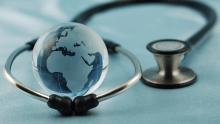
The Global Health major prepares students to address current and future public health issues around the world. Students develop cross-cultural and practical skills and competencies in epidemiology, policy, management, data analysis, world languages, and digital health to address complex health disparities globally.
Perfect for...
- those who are curious about public health and human rights in cross-cultural contexts
- students who want to apply classroom knowledge through experiential learning (locally or globally)
- those who want to build critical thinking, practical and world language skills that are essential to global health career readiness
Career Paths
- Policy Aide/Analyst
- Global Health Consultant or Advocate
- Research Assistant
- Legal Assistant
- Health Educator
- Monitoring, Evaluation and Learning Officer
- Program Manager
- Health Communication Specialist
Program Overview
The Global Health major is a highly interdisciplinary program that introduces you to foundations of public health (epidemiology, biostatistics, community and environmental health) in a cross-cultural context. Courses explore health systems, policies, inequities and illnesses through the lens of environmental, biological, geopolitical, socioeconomic, and cultural factors.
All global health majors engage in real world hands-on experience through research, internships, virtual global classrooms, or field work. Global Health graduates are equipped with skills in critical thinking, data analysis, and communication needed to succeed in careers and advanced study in global health policy, research or practice.
See all Global, Environmental, and Occupational Health student resources.
2024
Competencies
Upon completing a Bachelor of Science in Global Health, students should be able to:
- Explain mechanisms of human disease and identify evidence-based strategies to promote and protect health across the lifespan.
- Analyze how colonialism, economic systems, biological sciences, social determinants, power structures, and technological innovation have shaped global health approaches and outcomes.
- Apply epidemiological methods and research evidence to design interventions that address global health challenges.
- Collect, analyze, and interpret health indicators and statistical data to identify and characterize global health disparities across diverse populations and contexts.
- Evaluate how intersecting cultural, social, biological, economic, political, environmental, digital, and geographical factors influence population health outcomes.
- Design culturally appropriate, community-engaged global health interventions and policies that reflect local context and priorities.
- Produce scientific writing, oral presentations, and health communication materials that inform and motivate behavior change across diverse audiences.
- Collaborate across disciplines to develop, implement, and disseminate health information and communication strategies in multiple languages and cultural formats.
Program Requirements and Course Offerings
Global Health major requirements
For the Bachelor of Science in Global Health, students complete at least 69 credits (25-27 courses) of major-specific requirements in the following categories:
Global Health Supporting and Core Courses
Students in the global health major take courses taught by more than 12 departments across 6 UMD colleges. Global Health majors complete all of the following courses (53-61 credits):
AGNR
- NFSC100 Elements of Nutrition (DSNS)
ARHU
- World Language (student must demonstrate intermediate or higher proficiency, usually 0-2 courses)
BSOS
- ANTH210 Introduction to Medical Anthropology and Global Health (DSHS, DVUP)
- ANTH310 Method & Theory in Medical Anthropology and Global Health (DSSP, DVUP)
- GVPT200 International Political Relations or GVPT282 The Politics of Global Development (DSHS, DVUP)
CMNS
- BSCI170 Principles of Molecular & Cellular Biology + Lab (BSCI180 or BSCI171) (DSNL)
- BSCI213 The Public Microbe or BSCI223 Microbiology with lab (DSNS, SCIS)
INFO
- INST420 Data Applications in Global Health
SPHL
- FMSC110 Families and Global Health (DSHS, DVCC)
- SPHL100 Foundations of Public Health
- GBHL200 Introduction to Global Health
- GBHL210 Careers in Global Health
- HLTH230 Introduction to Health Behavior (DSHS)
- EPIB301 Epidemiology for Public Health Practice
- EPIB315 Biostatistics for Public Health Practice (FSAR)
- GBHL310 Introduction to Global Health Literacy
- HLSA320 Comparative Global Health Care Delivery Systems
- MIEH321 Environmental Determinants of Emerging Infectious Diseases
- GBHL497 Global Health Capstone (DSSP in major - taken in final spring semester)
Global Health Experiential Learning
Students complete two different global health experiences for academic credit (6 credits). Opportunities include research, internships, project-based virtual global classroom courses, and field work locally or abroad, and must be pre-approved by the program faculty.
Global Health Options
Students choose 4 additional courses that further explore concepts from their core courses or complement previous learning. At least 2 GBHL Options courses must be at the 300-400 level.
Course offerings
See current global health major courses and the terms they are offered.
- Global Health core and supporting courses
- World Language taught at UMD
- Approved Global Health Options courses
- Examples of Global Health Experiential Learning courses and programs
See days, times, and open seats in the UMD Schedule of Classes.
BS degree requirements
A Bachelor’s degree at UMD requires a minimum of 120 credits, generally consisting of:
- major requirements
- General Education requirements
- non-major electives
Some General Education courses can fulfill multiple GenEd categories and/or major requirements.
Total credits will depend on individual students' coursework at UMD and incoming transfer credit, including AP/IB credit.
- See undergraduate degree policies in the UMD Undergraduate Catalog
- See SPH and UMD academic policies and exceptions procedures
- See all SPH major benchmarks and sample plans
Career Development and Experiential Learning
Career paths from global health at UMD
Students who major in Global Health may go on to careers in policy, medicine, nursing, law, research, non-profits, advocacy, communications, or program administration.
By the time they graduate, students develop technical (R, Python, lab techniques and protocols), critical thinking, communication, cross-cultural and teamwork skills that employers value across industries.
Career exposure from day 1
In class, students learn from UMD faculty and guest speakers around the world who work in different fields of global health (policy, research, practice, technology, communication, program implementation, monitoring and evaluation).
All students in the Global Health major take the 1-credit Careers in Global Health course (GBHL210) as soon as the second semester of their freshman year. Through this course, students identify their current strengths and career goals, and prepare to engage in internships on or off campus, research or field experience, or even virtual collaborations on real world projects, for their Experiential Learning requirements.
Experiential learning requirement
Global Health majors complete 2 different experiential learning courses (6-9 credits). These may include internships, research independent study, project-based global classrooms courses, field work, or study abroad.
By the time they graduate, Global Health majors should be able to:
- Prepare for and gather contemporary knowledge about a location or community,
- Identify location-specific determinants (environmental, biological, political, sociological, economic, and/or cultural) that influence health,
- Ethically engage in the community, with humility and willingness to learn from others,
- Apply skills and strategies to address public health problems and challenges,
- Connect theoretical knowledge to real-world contexts, AND
- Reflect on experiences, noting changes in personal attitudes, interpersonal exchanges, and skill development.
Note: While an international experience is encouraged, travel is not required for the Global Health major.
Global Health majors have successfully applied to the UMD Fellows Program, Do Good Impact Interns and Accelerator Fellows, Peace Corps Prep program, Accelerated BS+MPH Program, and more unique programs at UMD and beyond.
Support across campus
The University Career Center@SPH provides students guidance in applying to internships or jobs, and preparing for life after college.
Students interested in specific career paths after college are encouraged to connect with the Reed-Yorke Health Professions Advising Office and the Pre-Law Professions Advising Office.
The National Scholarships Office advises students on applying for prestigious merit awards and fellowships, including but not limited to Boren, Gilman, Fulbright, Rhodes, Marshall, Udall, Hollings, Gates-Cambridge, and Knight-Hennessy.
Advising and Support
Global Health majors are supported in their academic and personal development by professional advisors in the School of Public Health and across the UMD campus.
Academic Support and Student Success
Students in the School of Public Health are supported by professional academic advisors in their department and college.
- GEOH department undergraduate advising
- School of Public Health Center for Academic Success and Achievement (CASA)
Double Majors, Minors, and Professional School Preparation
Many students combine the Global Health major with other academic programs or professional school prerequisites.
- Sample plans with Global Health + health profession or graduate school prerequisites
- Other sample Global Health major plans (double major or minor, language study, special programs)
Student Engagement and Leadership
Global Health majors are active in organizations throughout the School of Public Health and across UMD.
- The GEOH Student Organization connects undergraduate and graduate students with faculty and alumni to promote pre-professional development and collaboration for students in the fields of Global, Environmental, and Occupational Health.
- GEOH Student Ambassadors develop mentoring and public speaking skills as they assist current and prospective UMD students interested in our degree programs.
Become a Global Health Major
Current UMD students
Register for an asynchronous virtual major declaration workshop to build your draft graduation plan and then meet with a GEOH advisor:
- LAST SUMMER WORKSHOP! Sign up for the August 10 GBHL Major Declaration Workshop by noon on Wednesday, August 5 (UMD login to Google required to access the form.)
- Check the SPH Major Declaration page in August for Fall major declaration workshop dates
Newly-admitted freshman and transfer students
Are you enrolling at UMD for Fall 2026 or Spring 2027 and want to change your major to Global Health before your new student orientation?
Just email ApplyMaryland@umd.edu (and cc futureSPH@umd.edu). In your email include
- your full name,
- UMD UID,
- current major and
- major you want to change to (Global Health).
You may need to change your new student orientation date to align with SPH sessions. See your new student checklist.
If you already attended orientation for a different major, email gbhl@umd.edu to request information on changing to Global Health before the start of the fall semester.
Future Terps
Interested in Global Health? We encourage you to review the information about SPH Undergraduate Admissions.
High school students around the world can now take an online summer class with our faculty! (2027 Terp Young Scholars courses will be announced in late fall.)
High school and community college instructors and counselors who would like more information about the Global Health major can email gbhl@umd.edu to request a meeting or presentation.
For More Information
Dr. Hassanatu Blake
Director, GEOH Undergraduate Program
Ms. Catherine Donohoe
Assistant Director, GEOH Undergraduate Programs
(301) 405-3530
gbhl@umd.edu