
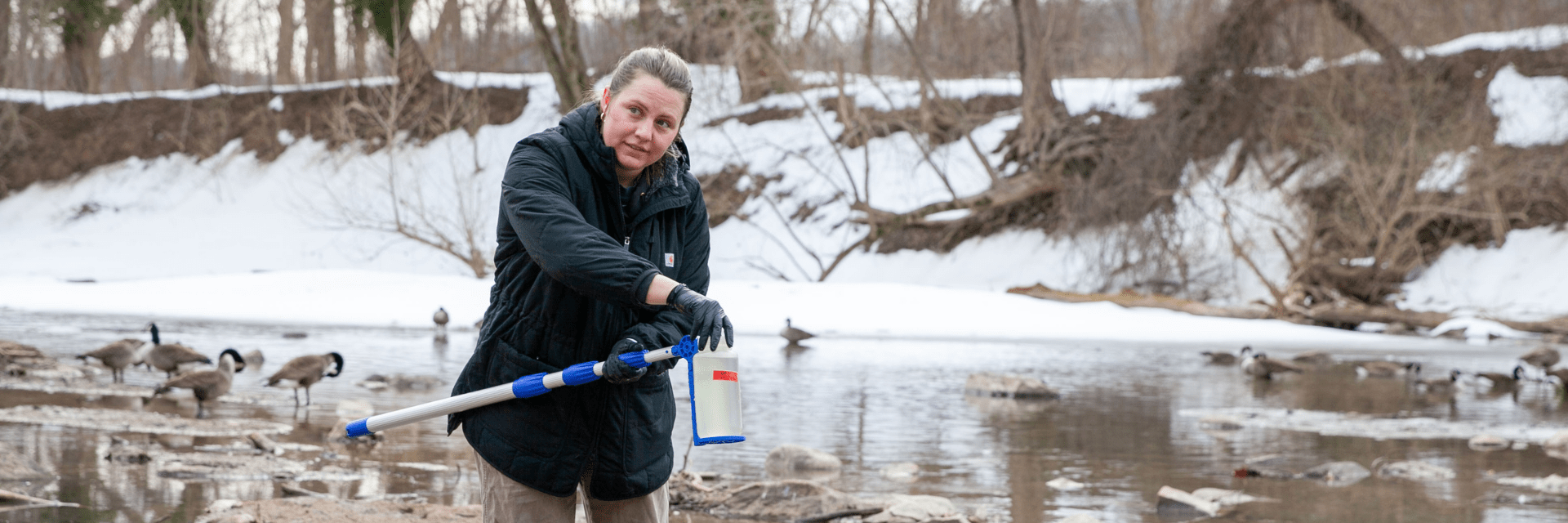

The Water Emergency Team is led by co-Principal Investigators SPH Assistant Professor in Global, Environmental, and Occupational Health (GEOH) Dr. Rachel Rosenberg Goldstein and Dr. Marccus D. Hendricks, associate professor of Urban Studies and (Environmental) Planning at UMD. WET is a joint venture between Goldstein’s Water Quality, Outreach, and Wellness (WOW) Laboratory and the Stormwater Infrastructure Resilience and Justice (SIRJ) Lab. WET was developed as a community-driven rapid-response to sewer overflows and backups in underserved African American communities in Baltimore and the surrounding region.
UPDATE: On Jan. 19, 2026, a large wastewater pipe broke and spewed sewage into the Potomac River in one of the largest wastewater spills in U.S. history. Since then, the group - in collaboration with the Potomac Riverkeepers Network - have been testing water and dirt samples for bacteria - including E. coli and S. aureus (staph) at both at the spill site and downriver. Learn more about initial testing results and analysis, and analysis of the sewer infrastructure failure that led to the spill:

-
UMD team finds E. coli, MRSA in Potomac River after sewage spill (2/5/2026 news release)
-
Elevated E. coli, staph still detected in Potomac river 4 weeks after sewage spill (2/20/2026 news release)

PI: Rachel Goldstein (SPHL), Assistant Professor, Department of Global, Environmental, and Occupational Health

PI: Marccus Hendricks (ARCH), Associate Professor, Urban Studies and Planning, Director of the SIRJ Lab
Additional Team Members:
- Priscila B. Ramalho Alves, Lab Manager and Post-doctoral Associate of the Stormwater Infrastructure Resilience and Justice (SIRJ) Lab
- Nick An, Doctoral Student in the Environmental Health Sciences Program at the University of Maryland School of Public Health
- Brienna Anderson-Coughlin, Post-Doctoral Associate in the in the Environmental Health Sciences Program at the University of Maryland School of Public Health, Global Environmental, and Occupational Health Department (GEOH)
- Claire Barlow, Doctoral Student in the Environmental Health Sciences Program at the University of Maryland School of Public Health, Global Environmental, and Occupational Health Department (GEOH)
- Kathryn Dixon, Doctoral Student in the Environmental Health Sciences Program at the University of Maryland School of Public Health, Global Environmental, and Occupational Health Department (GEOH)
- Maeghen Goode, Doctoral Student at the University of Maryland School of Architecture, Planning & Preservation
- Raisa Haq, Project Manager, Water Emergency Team
Grand Challenges
Grant Type: Team Project Grant
Website: Grand Challenges: Water Emergency Team
Topics: Water, Social Justice, Health, Climate Change
Colleges Represented: SPHL, ARCH
Exposure to raw sewage from failing infrastructure can lead to negative health outcomes, distress, and feelings of disenfranchisement, particularly in marginalized urban communities. Sanitary sewer overflows (SSOs), the release of untreated sewage from a municipal sewer system, affect several cities around the world, with as many as 75,000 occurring each year in the United States. Baltimore experiences frequent SSOs and household basement backups due to aging and failing sewer and stormwater infrastructure. As a result, communities are persistently exposed to raw sewage, likely containing waterborne pathogens and possibly antibiotic-resistant (AR) bacteria. While AR bacteria have been identified in wastewater at wastewater treatment plants, no studies have comprehensively evaluated exposure to these pathogens from SSOs or backups, nor the impact of physical damage to the home and infrastructure on communities. This project addresses these knowledge gaps by developing a community-driven rapid response Water Emergency Team (WET) to respond to SSOs and backups in underserved African American communities in Baltimore and the surrounding region. WET will complete visual household inspections, conduct residential surveys and interviews about impacts and experiences with these events, collect water and surface swab samples from impacted indoor areas, and analyze samples for AR bacteria, reporting results back to the community. WET will work directly with community organizations and neighborhood associations throughout the project, including translating research findings into an outreach program with the goal of empowering affected communities and informing local policymakers. Climate change will only continue to stress the U.S.’s crumbling infrastructure, disproportionately impacting marginalized communities exposed to raw sewage. The Water Emergency Team has the expertise, experience, and community partnerships to address these issues, bringing national attention and visibility for the university and communities alike.
Stay up to date with the latest WET Lab news and events.
News
What's Happening Now:
- How more than 240 million gallons of sewage flowed into the Potomac River (NPR) (February 20, 2026)
- Elevated E. coli, staph still detected in Potomac river 4 weeks after sewage spill (SPH UMD) (February 20, 2026)
- A historic sewage spill is flowing in the Potomac. Where is it headed? (USA Today) (February 19, 2026)
- Nearly 250 million gallons of raw sewage are flowing into the Potomac River (CNN) (February 17, 2026)
- Potomac Sewage Spill Becomes Ecological Disaster and Political Fight (New York Times) (February 17, 2026)
- UMD team finds E. coli, MRSA in Potomac River after sewage spill (UMD SPH) (February 05, 2026)
- University of Maryland Hosts Maryland Community Leaders to Strengthen Climate Resilience (UMD ESSIC) (February 05, 2026)
- How sewage overflow near Clara Barton Parkway could affect local environment (NBC Washington) (January 21, 2026)
- Water Emergency Team Advances Research and Community Outreach (UMD Division of Research) (September 30, 2024)
- Stormwater Hits D.C.’s Poorest Neighborhoods Hardest, UMD Study Finds (UMD Maryland Today) (June 3, 2024)
- Priscila Alves Presents at Community Forum, Environmental Justice and You: Stormwater Management at the Mount Rainier Nature Center for Her Talk Titled “Connections Between Environmental Justice, Climate Resilience, and Stormwater Management” (October 7, 2023)
- Rachel Goldstein Receives $1.3M NIH New Innovator Award to Support WET Project (UMD SPH) (October 3, 2023)
- Rachel Goldstein and Priscila Alves Present at the American Water Resources Association (AWRA) 2023 National Capital Region Water Resources Symposium on Friday (AWRA - NCRS) (April 14, 2023)
Events
Where is WET Now?:
2025:
- Saturday, April 12th, 2025
Bowie Green Expo - Saturday, April 26th, 2025
Montgomery County Greenfest 2025 - Saturday, April 26th, 2025
Maryland Day 2025, University of Maryland, from 1-3pm - Saturday, October 25th, 2025, Takoma Park Trunk or Treat Event
- Saturday, November 1st, 2025: Prince George's County Climate Stewards Academy Resource Roundtable
2024:
- Tuesday, February 27, 2024
Sandtown Community Meeting - Friday, September 6, 2024
University of Maryland First Look Fair - Saturday, September 7, 2024
Hyattsville Community Health and Wellness Fair from 10 AM - 2 PM - Sunday, October 6, 2024
Montgomery County Hispanic Heritage Month Fair and Festival 2024 from 12 PM - 5 PM
2023:
- Thursday, September 7, 2023
Belair-Edison Community Association Monthly Meeting - Friday, September 8, 2023
UMD First Look Fair - Tuesday, September 12, 2023
No Boundaries Coalition Monthly Membership Meeting
5:30pm-8:00pm - Thursday, September 14, 2023
Belair Edison Back to School Night
Thursday, 4:00pm - 7:00pm - Saturday, September 16, 2023
Love Groove Music Festival
12:00pm-7:00pm - Sunday, September 17, 2023
Irvington Community Farmers Market
8:00am-2:00pm - Sunday, September 24, 2023
Irvington Community Farmers Market
8:00am-2:00pm - Saturday, October 14, 2023
NewERA Baltimore Community Day - Thursday, November 9, 2023
Black Health Equity Summit
Contact Us
- Phone Number: 301-405-9171
- Email: wet@umd.edu