
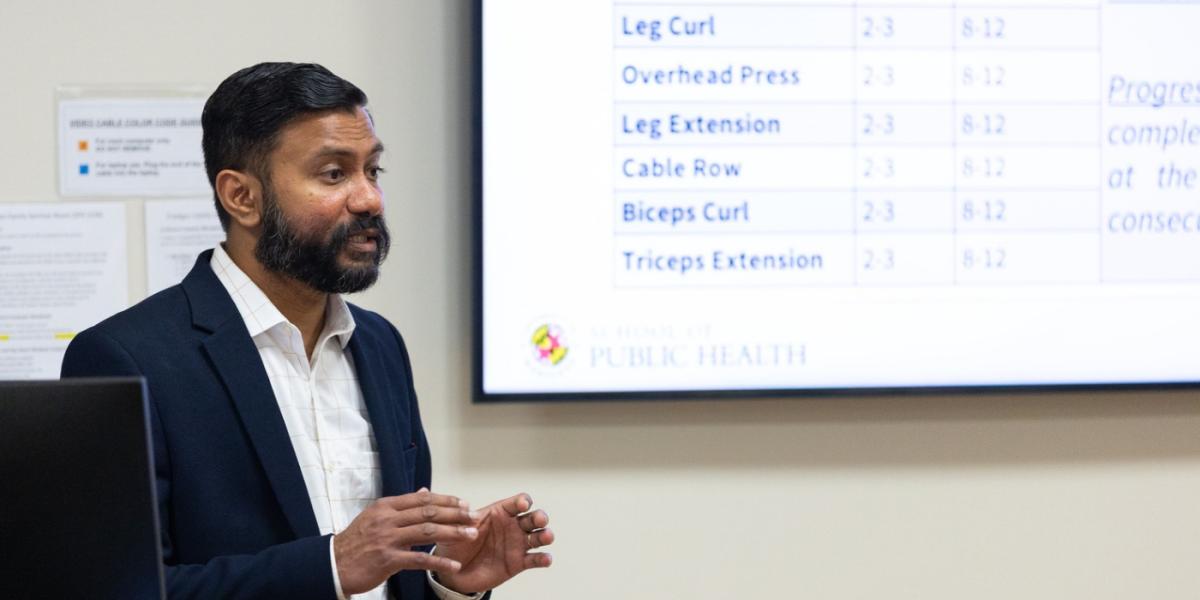
A $3.5 million, five-year grant from the National Institutes of Health will enable research led by the University of Maryland School of Public Health into whether strength training can reduce hypertension in post-menopausal women.
“Many women experience a double whammy during midlife with dramatic increases in blood pressure, weakened vascular health and menopausal transition. With this grant, we will investigate if resistance training — things like bench press and squats — can help,” said Associate Professor of kinesiology Sushant Ranadive, the study’s lead investigator.
“This study could provide millions of women a fairly accessible way to prevent hypertensive disorders and their dangerous consequences if our hypothesis proves correct,” said Ranadive.
Almost half of middle-aged women in the United States live with high blood pressure, a symptom-less condition that can lead to heart disease, stroke, kidney problems and dementia.
The grant will enable a multisite clinical trial, led by UMD with Iowa State University as co-site, over four months with 200 diverse women ages 40-64 who live with hypertension. Ranadive will work with cardiovascular and brain health expert Wesley Lefferts, an associate professor at Iowa State’s Integrated Health Sciences Program.
The study is expected to begin recruitment in November. Participation information will be released soon.
The grant reported in this release was supported by the National Institutes of Health under grant number 1R01MD021869-01A1. The total 100% of the grant is financed with federal funds. The content is solely the responsibility of the authors and does not necessarily represent the official views of the National Institutes of Health.
The University of Maryland (UMD) is the state's flagship university driven by a community of more than 50,000 fearless Terrapins. As a leading research university and top 20 public institution, UMD is proud to be part of the Association of American Universities. Dedicated to excellence and impact for the public good, the university is propelled by a $1.4 billion joint research enterprise. For more information about the University of Maryland, College Park, visit umd.edu.