
Cancer Control Research
The CHAMP lab conducts behavioral science and social epidemiological research in cancer control. Our interventional studies have historically focused on breast, prostate, and colorectal cancer screening, with an emphasis on implementation science. Our social epidemiological research studies the role of multi-level factors such as neighborhood conditions, in cancer control behaviors. The CHAMP lab works with local partners to increase early detection of breast, prostate, and colorectal screening. The CHAMP lab has been supported by agencies such as the National Cancer Institute and the American Cancer Society.
Department: Behavioral and Community Health
Room Number: SPH 1242W and 1101
Director: Cheryl L. Knott
Office Phone Number: (301) 405-6659
Email: cholt14@umd.edu
The CHAMP team is led by Dr. Cheryl L. Knott, PhD, a Professor in the Department of Behavioral and Community Health in the University of Maryland School of Public Health as well as Associate Director of Community Outreach and Engagement at the University of Maryland Greenebaum Comprehensive Cancer Center. Her research involves social epidemiology of cancer control behaviors, and implementation science research in cancer control interventions.
The CHAMP Lab is a team working on cancer control projects that aim to increase early detection of cancer in Maryland. We work frequently with local partners, building capacity to encourage early detection of breast, prostate, and colorectal cancer. Please feel free to reach out to Cheryl L. Knott, PhD at 301-405-6659 or cholt14@umd.edu if you have any questions, would like to discuss any of the CHAMP projects, or would like to explore a collaboration.
The CHAMP Lab seeks student volunteers to assist with supporting our activities including attending health fairs, assisting with cancer screening and education training and workshops, supporting our social media presence, and other lab research activities.
For information about student opportunities, check out our CHAMP Ambassadors information tab.
Our Project Team
Valerie Aldana, MPH, is currently pursuing her PhD in the Department of Behavioral and Community Health at the University of Maryland, School of Public Health. Prior to her doctoral studies, she earned her undergraduate degree in Biological Sciences and International Business from Florida International University in 2018. Afterward, she worked in cancer research at the University of Miami's Sylvester Comprehensive Cancer Center and the Baptist Hospital's Miami Cancer Institute until 2022. During her Master's program, completed at Florida International University's Robert Stempel College of Public Health & Social Work in 2020, she focused on public health, particularly in the field of epidemiology.
Eddie M. Clark, PhD, Professor, Department of Psychology, Saint Louis University is a social psychologist and does research on (1) health attitudes and persuasion including the development of culturally appropriate health messages and (2) close relationships especially satisfaction and commitment, infidelity, relationship maintenance, and the relationship between ex-romantic partners.
Bhumika Desai, MPH, MSc, BDS, is a second-year doctoral student in the Department of Behavioral and Community Health at the University of Maryland (UMD) School of Public Health. She is a Graduate Research Assistant supporting the Community Health Awareness, Messages and Prevention (CHAMP) Lab at the school of public health. She earned a Master of Public Health in Behavioral Sciences and Health Communication from Tufts University School of Medicine. Her research focuses on the impact of social and psychosocial determinants on cancer-contributing health behaviors in adults. She has a developing interest in exploring psychosocial resources as moderators of the association between stress and maladaptive coping behaviors in diverse populations. She is also a trained dentist and possesses a Master of Science in Clinical Research. As a clinician, she has extensive experience working on smokeless tobacco cessation in both urban and rural settings and has been involved in population-level screening for oral cancer in India.
Debs Ghosh, PhD, with a Ph.D. in Geography from University of Minnesota, MPhil in Population Studies, and a M.A. in Urban Development from Jawaharlal Nehru University, India Dr. Ghosh is currently an Associate Professor of Geography at UConn. She is also a PI of the Institute on Collaboration for Health Intervention and Policy, co-director of mHealth/ehealth research interest group, and affiliated with Yale University Center for Interdisciplinary Research on AIDS. As a health geographer, Debs’ research and teaching are primarily focused on the reciprocal relationship between ‘place’ and health, where place is a multidimensional unit, connecting people (vulnerable populations), things (facilitators and barriers), and environment. Central to this is her diverse yet complementary skill set including GIS, spatial statistics, social network analysis, mHealth (mobile-health), and more recently, designs of randomized controlled trials. Dr. Ghosh’s ultimate goal is to conduct ‘spatial behavioral interventions’ where research findings are translated to practice. Her current research, funded by NIH and foundations, among others include: mobile technology systems for medication adherence, healthcare utilization in the US, Uganda, and India, and disproportionate effects of housing foreclosures on health. Dr. Ghosh incorporates research into pedagogy by teaching seminars on ‘Health and Medical Geography’, ‘Spatial Analysis of Social Issues’, and a hands-on course on ‘GIS Applications in Health Research’.
Xin He, PhD, is Associate Professor and Associate Chair, Epidemiology and Biostatistics, in the University of Maryland School of Public Health. Dr. Xin He's current research focuses on longitudinal data analysis, time-to-event data analysis, nonparametric and semiparametric methods, as well as applications in epidemiology and biomedical studies.
Devlon Jackson, PhD, is a health communication scientist who examines how digital health can improve the health of vulnerable populations. She explores how consumers access and use these tools within and outside clinical settings and how providers use these tools to improve care. Within this work, she identifies communication inequalities contributing to access and use. She also understands that mental health impacts physical wellness; therefore, she assesses how digital health can support mental wellness.
Cheryl L. Knott, PhD, is a Professor in the Department of Behavioral and Community Health as well as Associate Director of Community Outreach and Engagement at the University of Maryland Greenebaum Comprehensive Cancer Center. In 2021, she was named an inaugural MPower Professor of the University of Maryland Strategic Partnership: MPowering the State. She is founding Director of the Community Health Awareness, Messages, and Prevention (CHAMP) research lab and the Editor-in-Chief of the peer-reviewed journal, Translational Behavioral Medicine. Dr. Knott holds a secondary appointment in the Department of Epidemiology and Public Health at the University of Maryland, School of Medicine. Dr. Knott's research program has generated more than $17 million in extramural support as Principal Investigator, from sources such as the NIH, CDC, and ACS. The program has resulted in more than 170 peer-reviewed publications, with many including students as co-authors.
Min Lian, MD, PhD, is Associate Professor of Epidemiology and Medicine in the John T. Millliken Department of Medicine, Division of General Medical Sciences, at Washington University in St. Louis. Dr. Lian is a Spatial Epidemiologist. His research interests focus on spatial-correlated epidemiological methodology and its application in cancer prevention and control. He has extensive training and research experience in Geographic Information Systems (GIS), spatial statistics, and Bayesian hierarchical modeling, aiming to i) identify geographic clustering/hot-spots, ii) develop modeling-based smoothing maps, iii) quantify spatial/temporal variations and spatial autocorrelation, and iv) construct indexed measurements of built neighborhood environments (e.g., walkability and spatial access to health/public services). Dr. Lian is also interested in gene-neighborhood interaction in cancer-related risk behaviors, such as cigarette smoking.
Asli McCullers, MPH, is a current PhD student in the Behavioral and Community Health Department at the University of Maryland, College Park. She is a Graduate Research Assistant supporting the CHAMP Lab (including the CHAMP Ambassadors program) and community engagement for the University of Maryland Greenebaum Comprehensive Cancer Center. Through an integrated health equity lens, her research interests are at the nexus of reproductive and maternal health, adolescent and young adult (AYA) cancer education and survivorship, and digital wellness. Additionally, Asli is a Research Specialist at the MedStar Health Center for Health Equity Research. Previously, she received her MPH in Epidemiology from the University of Delaware, her post-baccalaureate from University of Massachusetts Medical School in Clinical and Population Health, and her BS in Biology and Music Performance from Towson University.
Dr. Shana O. Ntiri, MD, MPH, is an Associate Professor in the Department of Family Medicine at the University of Maryland, School of Medicine. Dr. Ntiri has been the medical director for the Baltimore City Cancer Program at the University of Maryland Marlene and Stewart Greenebaum Cancer Center since 2010. She is a member of the Population Sciences Program within the University of Maryland Marlene and Stewart Greenebaum Cancer Center Program in Oncology, which fosters collaboration with investigators throughout the University of Maryland System to improve population-based cancer outcomes. Dr. Ntiri's research interests include cancer prevention, screening, and outcomes.
Crystal L. Park, Ph.D., is a Professor of Clinical Psychology at the University of Connecticut, Storrs. She studies multiple aspects of coping with stressful events, including the phenomenon of stress-related growth, and the making of meaning in the context of life-threatening illnesses, particularly cancer and congestive heart failure.
Tiffany Saavedra, M.H.S., is a current PhD student in the Department of Behavioral and Community Health at the University of Maryland School of Public Health, College Park. She supports multiple research projects within the CHAMP Lab and the University of Maryland Greenebaum Comprehensive Cancer Center. Tiffany also serves as the Senior Director of Transformation at VCU Massey Comprehensive Cancer Center and brings over 15 years of experience across global public health, clinical trials operations, research administration, and oncology research and development in community, academic, and industry settings. Her research interests include stress and cancer, cancer health equity, lifestyle-related cancers (e.g., tobacco control), and women’s health. She earned her undergraduate and graduate degrees from the Johns Hopkins University and the Johns Hopkins Bloomberg School of Public Health, respectively.
Mario Schootman, PhD, is Professor and Vice Chair of the Department of Medicine at the University of Arkansas for Medical Sciences. He conducts research in cancer treatment, informatics, and prevention. He studies geographic variation in cancer-related patient outcomes and uses real-world data (such as electronic medical records and claims data) to examine the effectiveness of cancer treatment.
Kathryn Vincent Carr, MA, is the Director of Operations for the Center on Young Adult Health and Development and the Office of Strategic Initiatives at the University of Maryland School of Public Health.
Beverly Rosa Williams, PhD, is a Gerontologist with expertise in qualitative research and life review with underserved populations. Her research interests include death, dying, bereavement, and palliative care.
Nathaniel Woodard, PhD, MPH, is a public health researcher working to promote health equity, particularly in the context of cancer-related outcomes. Woodard's research aims to understand the complex drivers of cancer health inequities and address them through evidence-based interventions. The primary focus of his research agenda is to employ community-based methods to design, implement, and evaluate sustainable interventions to improve quality of life, improve treatment outcomes, and reduce health disparities for those touched by cancer, with a particular emphasis on Black and African American populations.
Families, Friends, and Neighborhoods (FFAN) Study
This study is supported by the American Cancer Society. This study aims to determine the role of multi-level factors (e.g., neighborhood, individual, interpersonal) in cancer control behaviors in US residents. This study uses data from a national survey sample in addition to input from local residents to co-develop and distribute recommendations for cancer control practice, research, and policy based on study findings.
Project HEAL 2.0 (Health through Early Awareness and Learning)
Supported by the American Cancer Society, this study aimed to help local organizations get the word out about finding cancer early. Project HEAL focuses on breast, prostate, and colorectal cancer, three of the main causes of cancer death. We train Cancer Health Ambassadors to become certified to teach cancer early detection workshops in local organizations.
University of Maryland Greenebaum Comprehensive Cancer Center (UMGCCC) Cancer Needs Assessment
This needs assessment, supported by the UMGCCC, aimed to learn more about the cancer knowledge, beliefs and behaviors of residents who live in the 10 county UMGCCC service area (Anne Arundel, Baltimore/Baltimore City, Carroll, Charles, Frederick, Harford, Howard, Montgomery, Prince Georges, and Washington). Information from the survey helps the UMGCCC better understand the needs of Marylanders living in the service area and use that information to develop future cancer education, outreach, treatment and research activities.
CHAMP Ambassadors is a volunteer-driven community of practice for undergraduate students at the University of Maryland and beyond who are interested in raising awareness around cancer prevention through a health equity lens. Our core focus areas are:
- Social media and health communication, where we create informative infographics on cancer-prevention related topics.
- Peer education, where develop young-adult oriented cancer prevention content to deliver to student organizations on campus.
- Community engagement, where we provide educational material at health fairs, trainings and other events throughout the state of Maryland.
- Research support, where our undergraduate students can gain experience assisting in our studies, funded by agencies such as the American Cancer Society and National Institutes of Health.
Since our inception in 2024, we have welcomed over 20 undergraduate ambassadors from UMD and other universities, including Johns Hopkins University, and have engaged with 1000+ community members through our community, campus and digital efforts!
To learn more about CHAMP Ambassadors and to get involved, please email Asli McCullers, CHAMP Ambassadors Coordinator, at amccull5@umd.edu
For alternative opportunity inquiries, please email your resume and statement of interest to Dr. Cheryl Knott, Director, at cholt14@umd.edu.
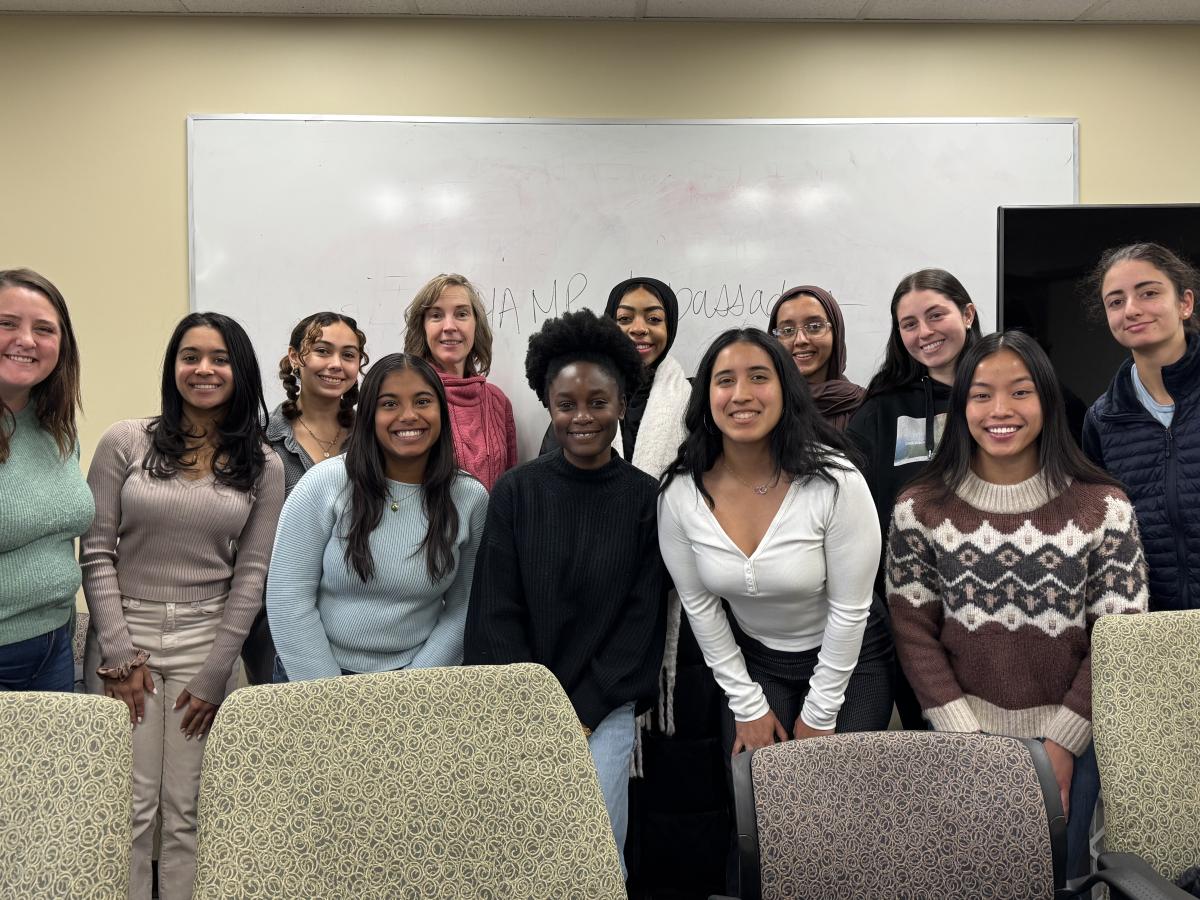
CHAMP Ambassadors - leading the future of cancer education and prevention!